Title text:
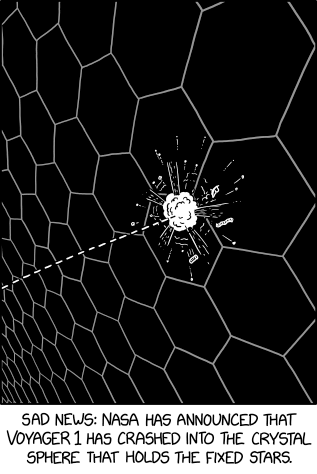
[Several months later] Actaully, it looks like what it hit a few months ago was just the START of the crystal sphere zone. New data confirms Voyager 1 has now struck the ACTUAL crystal sphere.
Transcript:
Transcript will show once it’s been added to explainxkcd.com
Source: https://xkcd.com/3326/
You must log in or register to comment.
“Astronomers are starting to see glitches in their observations of Voyager 1 as it goes beyond the back rendering plane of the simulation”
Well that would be a discovery for deathworlders
Whoever is running the simulation must be busy with generating new data as we keep looking further and deeper and lower. At some point we’ll break their machine.
That actually reminds me of a sci-fi book I read ages ago. I can’t remember much about it, but it was set in the not-too-distant future, a couple of decades after the entire solar system had suddenly been sealed off from the rest of the universe inside an opaque bubble by outside forces. The reason was believed to be that human observation - and human observation alone - could collapse the uncertainty waveform and that as humans were peering deeper into the universe it was causing mass extinctions in lifeforms whose biology existed across a range of uncertainties as well as spatial dimensions.
this is my favourite take on how magic should work in fantasy. Some things thrive in the chaos where things don’t have to make sense, but to creatures like us it’s generally just lethal because we do be relying on atoms being a concept.
Imagine venturing into the feywilds and physics just starts breaking down the further you go…
At first it’s fine and you just start being able to influence reality by believing really hard in things, but at some point you have to actively enforce the world around you or you’ll go weightless because gravity just doesn’t actually exist any more, and if you keep going further you face straight up cognitohazards because anyone who is aware of nuclear forces will just dissolve unless they force themselves to fully believe that it’s either not actually real or that it doesn’t matter here.
From the explanation text:
As it sets new distance records, it repeatedly crossed various boundaries which could be considered the edge of the Solar System
The title text pokes further fun at the arbitrariness of these boundaries by re-casting the crystal sphere as a “crystal sphere zone”, making what would otherwise be an objective boundary subjective and fuzzy again. This is a reference to the “crying wolf” period in 2013 of repeated Voyager 1 articles claiming that it had left the solar system.
This is particularly funny if you were following V1 and V2 even before 2013, starting in 2003, say. The probes kept finding new regions of the heliosphere as they went, with the instruments witnessing quite unexpected behaviour in terms of the “flow” of interstellar material out there. And that was even after “hitting the wall” where the solar wind flow drops below supersonic. Hell, we’re still coming across discrete boundaries and structures in the plasma even now, when most heliophysicists are sure the probes have gone interstellar. For a few years back there, I wondered if even the faster V1 would ever reach the “edge”, whatever that means. It sure took a while; before the Voyagers launched, some of the scientists thought we’d reach the solar wind boundary around freaking Saturn…
Better not show this xkcd to the Flat Earth types. If they do show up, though, we can always trot out one of those good old Richard Matheson Twilight Zone bogeymen to keep them in their place.
And that was even after “hitting the wall” where the solar wind flow drops below supersonic.
What does “supersonic” even mean in the context of the outer solar system? I assume it has no relation to the 700ish MPH that it is in air at STP.
The medium here is the solar wind plasma as opposed to Earth’s atmosphere, but the waves are still acoustic, so the term “supersonic” is used widely in this sort of magnetohydrodynamic space physics. At 300-400 km/s, or often even faster, the outward-flowing solar plasma outruns the waves generated within the plasma itself (as it interacts with the weak magnetic fields). So yes, your assumption was correct.
Somehow I still have to actively force myself to not thinking there is something like this when looking at the nightsky. And then it’s always such a surreal realization that I am actually looking into vast deep infinite space and also thousand, million, billion years into the past.
Imagine if it broke and shattered. Would be some shit.
There’s a short sci-fi story by Stephen Baxter about something very similar to this. Humanity manages to resolve a planet around one of the stars of Alpha Centauri and finds a way to bounce a laser off it in such a way that we’d see the reflection after about 8 years.
… except things don’t go quite how they expect. Reality itself starts glitching as the humanity of that universe begins to realise that they weren’t expected to have been able to reach that far. At least, maybe not yet…?
Come on, where’s the title?
“Touching Centauri”
Edit: Somehow also reminds me of Asimov’s “The Gods Themselves”
Of course it did. Got to keep that phlogiston out of wild space.